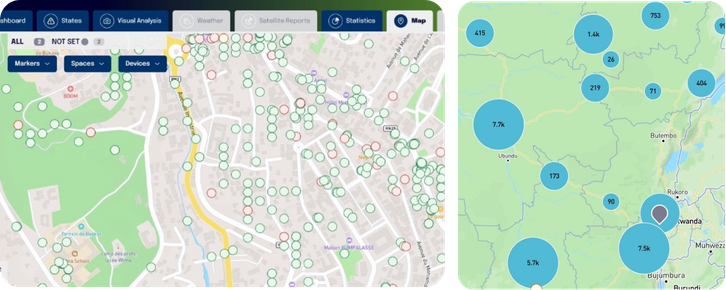
Distribution of electric induction stoves and improved firewood cookstoves in residential areas.
Annual checks on the use and effectiveness of the cookstoves.
Reduction of GHG emissions.
The purpose of this project is to reduce greenhouse gas (GHG) emissions from the burning of non-renewable biomass (firewood/charcoal) and fossil fuels for cooking, and to contribute to sustainable development in the Democratic Republic of the Congo. The project will distribute induction cookstoves and improved firewood stoves to domestic households.
The lack of access to clean cooking remains very acute in sub-Saharan Africa, with only 17% of the population having access to clean cooking. The vast majority of people in sub-Saharan Africa rely on gathering biomass for cooking, which dramatically deteriorates health and impairs productivity improvements. Almost 490,000 premature deaths per year are related to household air pollution from the lack of access to clean cooking facilities, with women and children affected the worst.
CORSIA eligibility
CORSIA-eligible: The project’s credits are positioned as CORSIA-eligible, enabling use for aviation decarbonisation alongside voluntary climate commitments.
Uplifting Communities Through Clean Energy in the DRC
This energy efficiency project is focused on uplifting communities through clean cooking solutions in the Democratic Republic of the Congo (DRC). By replacing traditional and inefficient cooking methods with induction cookstoves and improved firewood stoves, the project aims to reduce emissions while enhancing health, safety, and economic resilience.
Loading map…
SDG Impact
The project is designed to contribute to multiple Sustainable Development Goals (SDGs), with a particular focus on climate action, poverty reduction, health, energy access, decent work, responsible consumption and production, and life on land.
Reduced Energy Costs – No Poverty
Users will be able to reduce household energy costs and improve their financial situation by lowering reliance on kerosene and wood.
Reduced Illness Risk – Good Health and Well-Being
The project’s stoves will reduce smoke and indoor air pollution, improving respiratory health and reducing illness risks.
Essential Activities – Time Savings
By reducing time needed for wood collection or fuel purchases, users gain more time for essential daily activities.
Affordable Energy – Clean Energy Access
Reduced fuel demand for cooking improves access to clean and affordable energy for households.
Employment Opportunities – Decent Work
The project creates new job opportunities for both men and women, promoting inclusive economic growth.
Cookstove users lower their fuel use by more than half, reducing both household costs and environmental impact.
507,323 tCO₂e – Climate Action
GHG emissions will be avoided yearly through thermal efficiency, making a direct contribution to global climate mitigation efforts.
Fuel Wood Savings – Life on Land
Lower wood consumption conserves forests and contributes to environmental protection and sustainability.
Emission Reduction Plan for the First 5 Years.
The emission reduction plan outlines the expected tCO₂e savings for the first five years of the project:
Year
ICS
Induction
Combined ER
2025 – 2026
9,812
39,555
49,367
2026 – 2027
213,028
105,480
318,508
2027 – 2028
340,218
184,590
524,808
2028 – 2029
586,414
249,821
836,235
2029 – 2030
571,754
235,942
807,696
Total Emission Reduction Over 5 Year
1,721,226
815,388
2,536,614
Integrity Beyond Standards Through AI-Based Real-Time Monitoring
Our project is equipped with a digital MRV system, providing real-time, verifiable data across the entire carbon project lifecycle—from installation to impact tracking. This includes a PAYGo system that monitors cookstove usage in real time via smart meters and mobile connectivity, capturing key data such as usage hours, battery performance, and actual CO₂ savings, ensuring full transparency and accountability for every device in the field.
Registry & Methodology
Gold Standard's GS4GG
“Reduced emission from cooking and heating”, TPDDTEC v.4.
Let’s Bridge the Gap to Net Zero
Discover how Econetix can help you verify, manage, and scale your carbon assets with confidence.
We use cookies to personalize content and ads, to provide social media features, and to analyze our website traffic.
We also share information about your use of our site with our social media, advertising, and analytics partners.
We only load analytics via Google Tag Manager when you allow statistics cookies. You can change your choice anytime
by clearing your browser storage.