


For many airlines, the 2027 CORSIA deadline still feels distant. It is not. The monitoring systems, verified reporting, and eligible-credit procurement needed for full compliance take time to build, and carriers that leave it to the final year risk verification delays, cost uncertainty, and regulatory pressure. Moving into the mandatory phase is not simply about buying carbon credits. It is about operational readiness, data accuracy, and disciplined compliance management.
This guide sets out what CORSIA actually requires, how the obligation is calculated, what makes a credit eligible, and the concrete steps to take before 2027.
What is CORSIA and Why It Matters for Airlines
CORSIA, the Carbon Offsetting and Reduction Scheme for International Aviation, is ICAO’s global market-based measure to limit the net CO₂ emissions of international flights above a fixed baseline. It is not a tax and not a cap-and-trade system. Airlines monitor and report the emissions of their international flights and, for growth above the baseline, cancel eligible emissions units to offset it.
Coverage runs on a phased timeline: a pilot phase from 2021 to 2023, a first voluntary phase (CP1) from 2024 to 2026, and a mandatory second phase (CP2) from 2027 to 2035. 130 States participate in CP1 as of January 2026; from 2027, participation becomes mandatory for nearly all ICAO States, with exemptions only for least developed countries, small island developing States, landlocked developing countries, and States below 0.5% of global traffic. For leadership teams, CORSIA is therefore a regulatory obligation that touches finance, systems, and procurement, not only a sustainability commitment.
Key CORSIA Compliance Requirements for Airlines
CORSIA works in two layers, and keeping them apart is the key to reading your own position correctly.
Monitoring, reporting and verification (MRV) applies to nearly every operator. Since 2019, any operator whose international flights emit more than 10,000 tonnes of CO₂ per year, flown with aircraft above 5,700 kg maximum take-off mass, must monitor fuel burn, convert it into CO₂ (fuel × 3.16), and submit an annual emissions report that an accredited independent verifier has checked before it reaches the national authority. Domestic flights are never in scope. Smaller operators may use ICAO’s CERT tool to estimate fuel burn instead of full monitoring.
Offsetting applies more narrowly. It covers only emissions on routes between two participating States. A route touching a non-participating State still has to be reported, but carries no offsetting requirement during CP1.
Treat monitoring and procurement as one connected compliance process, not two. Weak MRV data in 2026 turns into disputed baselines and rushed, expensive purchasing later.
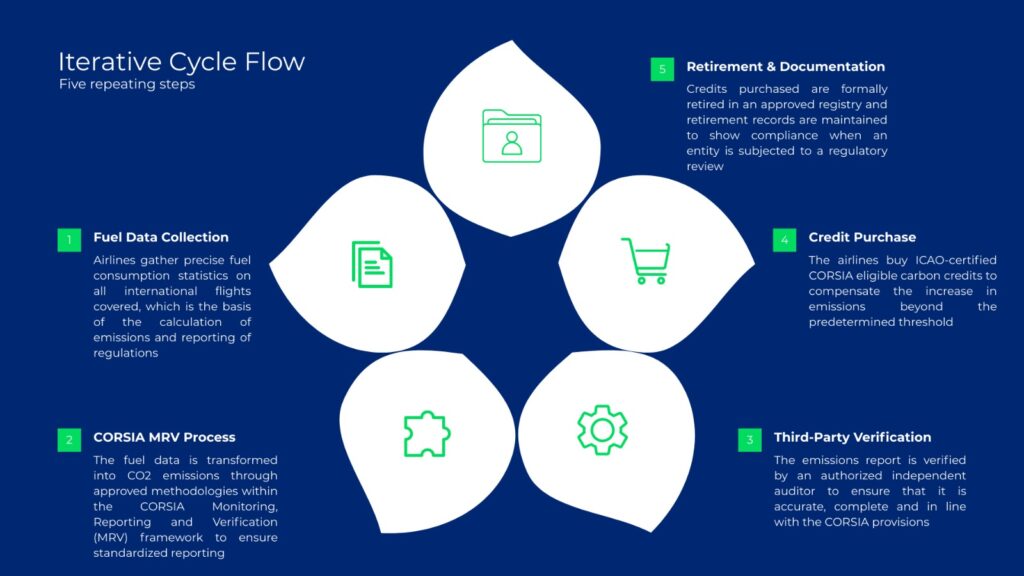
Figure: Iterative Carbon Offset Compliance Cycle in Airlines.
Carbon Offset Requirements Under CORSIA
The offsetting obligation is driven by sector growth, not by an airline’s own total emissions. The baseline is 85% of 2019 emissions for the years 2024 to 2035. Each year, ICAO publishes a Sector’s Growth Factor (SGF): the share by which the sector’s covered emissions exceed that baseline. An operator’s annual requirement is its covered-route CO₂ multiplied by the SGF, the same rate for every airline (100% sectoral through 2032). For 2024, the first year with a real obligation, the SGF was 15.4%.
Not every carbon credit qualifies. A CORSIA-eligible unit (a CEEU) has to clear several gates, and eligibility matters more than price:
- It is issued under a programme approved by the ICAO Council for the relevant compliance period, for example Gold Standard, Verra, ACR or ART.
- Its vintage and activity fall inside the approved eligibility window.
- The host country has issued a Letter of Authorisation (LoA) authorising the credit for CORSIA use.
- The host country applies a corresponding adjustment under Article 6 of the Paris Agreement, so the same reduction is not also counted toward its own climate target. This is the safeguard against double counting.
- The unit carries the CORSIA-eligible label in the registry and can be cancelled with an attribution to your airline and compliance period.
This is the point most often missed: a credit with a serial number and a retirement record is not CORSIA-eligible unless it also carries a host-country LoA and a corresponding adjustment. Without those, even a high-quality credit becomes a compliance liability rather than an asset.
The Eligible-Supply Reality
Eligible supply, not demand, is the real constraint. As of June 2026, only about 38 million eligible units existed, against first-phase demand estimated at around 163 million tonnes in the base case. Because host-country authorisation and the corresponding adjustment are sovereign acts, only a handful of countries can currently issue LoAs and carry the adjustment through, so approved-programme status alone does not create supply. Airlines that secure LoA-backed volume early avoid competing for scarce credits in the run-up to the January 2028 cancellation deadline.
The 2027 Mandatory Phase: What Airlines Must Prepare For
The move into CP2 turns CORSIA from a voluntary commitment into a full regulatory obligation across most international routes between participating States. Preparation before 2027 should focus on three things: strengthening MRV systems and validating calculation methodologies, modelling offset exposure under low, central and high SGF scenarios, and securing eligible supply through structured procurement rather than a year-end purchase.
The compliance calendar is fixed. Final CP1 offsetting requirements are notified by 30 November 2027, eligible units must be cancelled by 31 January 2028, and the verified cancellation report is due by 30 April 2028. A mid-sized carrier with several long-haul routes that misjudges its baseline growth, or waits to buy, can face an unplanned bill exactly when every other carrier is competing for the same thin supply. Early modelling and early contracting remove that risk.
How Econetix Helps Airlines Prepare
Econetix is a carbon asset manager and a partner in the IATA CORSIA Supporting Alliance that develops and operates its own portfolio of CORSIA-eligible projects across the DRC, Uganda, Rwanda and the Maldives, and was among the first developers globally to secure Letters of Authorisation for Phase 1 compliance credits. Buying direct from the developer, rather than through an intermediary, gives airlines competitive pricing, delivery guarantees backed by a binding supply obligation, and full traceability of LoA and corresponding-adjustment status. Combined with forward-purchase and deferred-payment structures, this lets procurement teams lock in eligible volume and price ahead of a tightening market.
Conclusion: Preparing for CORSIA Compliance Before 2027
The shift to the mandatory phase makes CORSIA compliance a hard regulatory requirement, not a policy debate. Airlines that build robust MRV, understand exactly how the offsetting obligation is calculated, and secure LoA-backed eligible supply in advance will enter 2027 in control rather than under pressure. CORSIA compliance before 2027 is, above all, about preparation.
Frequently Asked Questions (FAQs)
What does CORSIA compliance require airlines to do?
Monitor and report the CO₂ of their international flights, have those reports checked by an accredited independent verifier, and cancel CORSIA-eligible credits to offset emissions growth above the baseline.
Who must comply with CORSIA MRV?
Any operator of international flights emitting more than 10,000 tonnes of CO₂ per year with aircraft above 5,700 kg MTOM, in place since 2019, regardless of whether its home State participates in the voluntary phases. Offsetting applies only between participating States.
What is the CORSIA baseline?
For 2024 to 2035 it is 85% of 2019 emissions. Offsetting is owed on the sector’s growth above that baseline, applied through the annual Sector’s Growth Factor.
What makes a carbon credit CORSIA-eligible?
It must come from an ICAO-approved programme, sit within the approved vintage window, carry a host-country Letter of Authorisation with a corresponding adjustment under Article 6, and be tagged as CORSIA-eligible in the registry.
When are the key CP1 deadlines?
Final offsetting requirements are notified by 30 November 2027, eligible units must be cancelled by 31 January 2028, and the verified cancellation report is due by 30 April 2028.
How does third-party verification work?
Before an airline submits its emissions report to the national authority, an accredited independent verifier reviews the data and methodology to confirm it meets ICAO’s requirements.
