


How CORSIA Compliance Works: Baselines, Phases, and Reporting Explained
CORSIA Compliance is no longer a far-off regulatory framework that is discussed in sustainability briefs. It is now the way that airlines measure fuel burn, organize reporting systems and predict operating costs. With the international traffic rebounding, the growth of emissions is coming back and along with it, offset obligations.
In many carriers, the point of turnaround was the realization that CORSIA is not merely about purchasing carbon credits. It is about developing dependable internal systems that can withstand scrutiny when subjected to verification processes as mandated by ICAO CORSIA rules.
What is CORSIA and Why Does it Matter for Airlines?
The International Civil Aviation Organization adopted the Carbon Offsetting and Reduction Scheme for International Aviation to deal with the rise in international aviation emissions. Rather than using strict fuel limits, ICAO CORSIA uses Carbon Offsetting in Aviation to stabilize net emissions at 2019 levels. Practically, CORSIA Compliance requires airlines to track the consumption of fuel within the international flights and compensate for excess carbon emissions that surpass the agreed CORSIA Baselines. In case emissions increase more than what was registered in 2019, the airline will be required to buy eligible carbon credits in order to offset the increase. This model maintains flexibility in operations. However, growth now has a quantifiable price. CORSIA Implementation is important because it brings about global alignment. The Aviation Emissions Reduction policies were once very different across regions. The divided strategy generated legal uncertainty.
The mechanism has created a standardized monitoring and offsetting framework among the participating states that lowered international regulatory tension. Experience shows that the greater compliance burden typically lies beyond the offset transaction itself.
CORSIA Baselines and Phases
The CORSIA Baselines serve as the benchmark against which emissions growth is assessed. Following disruptions due to the pandemic, the baseline was established at 2019 emissions. This ruling constrained future obligations for airlines bouncing back into growth. The scheme is conducted in specific CORSIA Phases. The pilot phase ran from 2021 to 2023. The first phase covers 2024 to 2026. They are both voluntary to participating states. Under ICAO CORSIA, most states with intensive aviation activity will be required to participate between 2027 and 2035. The compliance calculation methodology changes significantly in 2027.
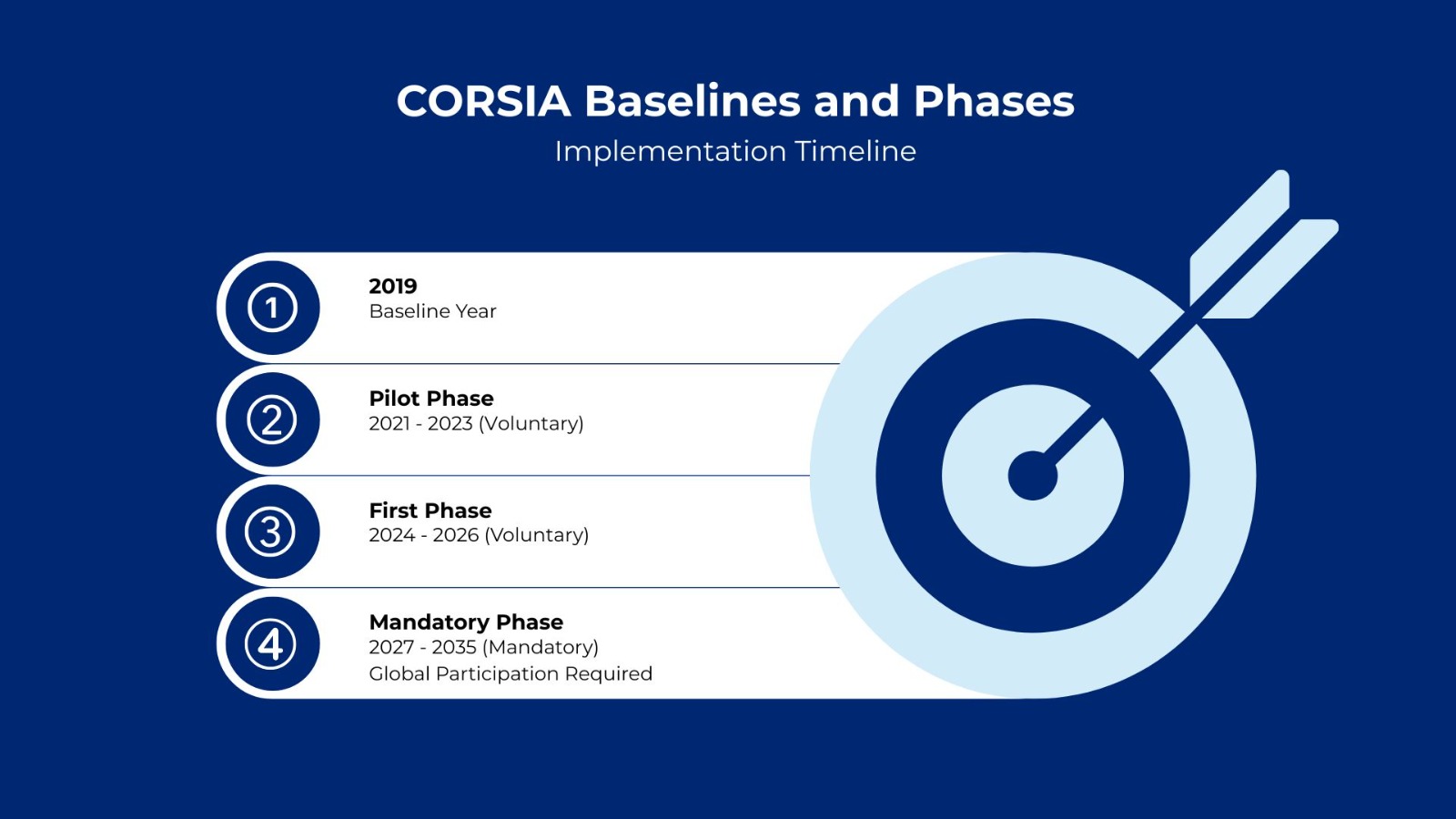
Figure: CORSIA implementation timeline showing the 2019 baseline and transition to the mandatory phase (2027–2035).
Initial stages estimate offset commitments based on industry growth to a significant extent. With time, the formula shifts towards the performance of individual airlines. This implies that carriers that move at a higher rate than the global average could have the risk of experiencing increased offset exposure. Take the case of a middle-size global airline penetrating Southeast Asia routes. With traffic higher than in 2019, its emissions are higher than the baseline. That incremental growth under the CORSIA Compliance directly converts into offset purchasing obligation. When the fleet renewal is delayed the cost impact is even greater.
To plan this transition, proper emissions projection is needed. Airlines considering CORSIA Implementation like static reporting might underestimate future exposure. The other crucial factor is traffic volatility. Airlines rarely develop in a straight flow. The annual emissions can vary significantly due to seasonal changes, geopolitical turnover, as well as fuel price changes. According to the framework, those fluctuations have a direct effect on offset volumes. One year of increased route growth or high passenger traffic can soon escalate into increased credit procurement requirements. This would imply that in the case of finance teams, the emissions forecasting must be integrated with the commercial planning rather than viewed as an independent sustainability exercise.
CORSIA Reporting and Verification Requirements
The CORSIA Compliance is built on CORSIA Monitoring and Reporting. Airlines are required to come up with approved monitoring plans including the calculation of fuel consumption and CO₂ emissions on covered routes. The CORSIA Reporting Requirements specify the reporting of verified emission data on an annual basis. These reports are audited by certified third-party auditors in formal CORSIA Verification Requirements. The process of verification is not a formality. Internal controls, data consistency, sampling methods, and trails of documentation are evaluated by the auditors. The lack of strong data governance may lead to corrective discoveries, delays or reputational issues. In reality, miscalculation is not the most prevalent compliance problem, it is incomplete documentation. Minor inconsistencies in the records of fuel uplift in various jurisdictions may lead to further investigation.
Airlines also have to make sure that purchased offsets are of ICAO Carbon Credit Certification standard. Credits that are accepted under the ICAO CORSIA are only considered compliant. The acquisition of ineligible units is subject to regulation exposure, although volumes may look adequate on paper. CORSIA Compliance thus covers operations, finances, procurement and the regulatory monitoring. It is not limited to sustainability departments.
The Future of Aviation Emissions Reduction Under CORSIA
Aviation Emissions Reduction according to CORSIA will gradually overlap with more extensive decarbonization strategies. The adoption of sustainable aviation fuel, efficient fleet operations, and efficient route planning will determine the exposure to Carbon Offsetting in Aviation in the long term. The goal of offsetting was to be a transitionary tool. Offsetting does not eliminate emissions; it compensates for growth while long-term decarbonization technologies scale.
During the mandatory stage, offset demand might also be high as the traffic increases. Those airlines that invest in fuel-efficient aircraft can mitigate the number of credits needed under CORSIA Compliance. The ones that delay modernization may encounter a greater cost pressure as the market prices of the eligible units become tight. There is the aspect of reputation, too. The trust of the market in ICAO Carbon Credit Certification standards is paramount in preserving the credibility of ICAO CORSIA. More intense oversight and questioning of regulators and investors is probable as 2027 comes closer. CORSIA Implementation is also becoming more integrated with the wider ESG reporting mechanisms. Financial risk assessment is the new way investors and lenders are looking at how airlines deal with carbon exposure. Clear reporting of offset strategies, credit quality and verification results is emerging as a mainstream corporate reporting practice.
In this regard, CORSIA Compliance does not only play a role in ensuring compliance with the regulations, but also enhancing capital market credibility.
To the leadership teams, the question is no longer whether or not this framework is applicable. It is the level to which they are able to incorporate it into long-term operating models.
Preparing for CORSIA Compliance
As the 2027 mandatory phase nears, CORSIA Compliance should be viewed as a future governance challenge by airlines and not a technical reporting exercise. The immediate priorities include strengthening the CORSIA Monitoring and Reporting systems, engaging accredited verifiers at the initial stage of work and harmonizing the data controls within the company. Forecasting models of emissions must be stressed on growth scenarios. It is also essential to gain access to qualified credits using the ICAO Carbon Credit Certification. Financial planning should incorporate carbon procurement plans long before the offset obligations become high. Preparation in advance minimizes the uncertainty. The delay of action increases cost exposure. The CORSIA Compliance has become part of the global aviation regulation. With the scheme maturing, airlines that are strategically prepared will better manage the financial and operational risk.
Econetix provides direct CORSIA-eligible supply from projects we own, helping you plan volumes early and match delivery to your CORSIA requirements.
Frequently Asked Questions (FAQs)
What is the CORSIA program and how does it work?
CORSIA is a global carbon offsetting scheme adopted by the International Civil Aviation Organization to stabilize net CO₂ emissions from international aviation at 2019 levels. In CORSIA Compliance, airlines compensate for their expansion of emissions by acquiring qualified carbon credits.
How does CORSIA affect airlines' emissions reporting?
CORSIA Compliance requires airlines to monitor fuel use and compute CO₂ emissions and present annual verified reports. Such reports should be of CORSIA Monitoring and Reporting standards and should be independently verified prior to offset obligations being determined.
What are the key phases in CORSIA's implementation?
The phases of CORSIA are Pilot Phase (2021-2023), First Phase (2024- 2026), and mandatory phase (2027- 2035). Since 2027, it is clear that the offset obligations are more indicative of the growth of each airline instead of the industry average.
How can airlines prepare for CORSIA compliance by 2027?
The airlines must enhance internal reporting systems, improve emissions forecasting, and obtain approved credits in line with ICAO Carbon Credit Certification standards. Early preparation eliminates financial exposure and verification risk after mandatory CORSIA Compliance starts.
What financial impact will CORSIA have on airlines?
CORSIA Compliance adds to the operating expenses because the airlines have to purchase carbon credits when their emissions increase, which usually increases with a faster pace, resulting in higher expenses.
