


Event Carbon Footprint: How to Calculate It (2026 Guide)
Every event leaves an environmental footprint — from the energy it consumes to the waste it generates and the travel it requires. Understanding your event carbon footprint is the first step toward meaningful sustainability.
In 2026, businesses and event planners face growing pressure to measure and reduce their emissions. Whether you’re organizing a corporate seminar or a large-scale festival, knowing your carbon footprint is no longer optional — it’s expected.
This guide walks you through the process — step by step, practical, and without the jargon.
Event Carbon Footprint: What is it?
An event carbon footprint is the total of all greenhouse gas emissions an event generates — from transportation and electricity to catering and waste.
Understanding this impact helps planners pinpoint where emissions come from — and how to minimize them.
For example, an event of global participants will have a significantly larger footprint compared to a local workshop, primarily because of travel emissions. That is why proper carbon footprint calculation matters: it replaces assumptions with clarity.
The Significance of Measuring Event Emissions
Calculating your event’s carbon footprint goes beyond reporting or compliance — it enables better decisions.
Tracking emissions allows you to set achievable reduction goals. It also enhances transparency, which is increasingly expected by clients, sponsors, and attendees.
Beyond that, it strengthens your overall approach to sustainable event management. Companies that actively measure and reduce emissions are seen as more responsible — and they attract more business.
Calculating Event Carbon Footprint (Step-by-step):
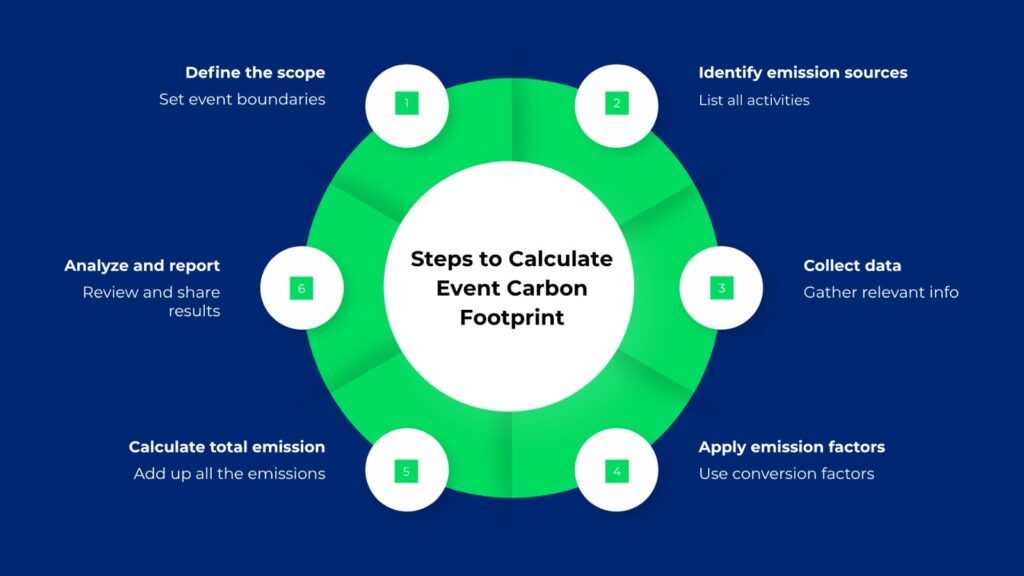
Figure: An event’s carbon footprint calculated step-by-step
Step 1: Determine the Scope of your Event.
The first step is deciding what is to be included in your Event Carbon Footprint. This involves setting clear boundaries.
Is attendee travel going to be included? What about vendor logistics or accommodation? The more accurately you define your scope, the more accurate your Carbon Footprint Calculation will be.
The majority of event planners categorize the emissions into three key areas: direct emissions, indirect emissions through energy and other indirect sources such as travel and supply chains.
Step 2: Determining the Sources of Emissions.
The next step is to make a list of activities that generate emissions.
This involves transport, use of electricity, food and catering, accommodation, materials and waste. All these will add to your total Event Environmental Impact.
The most significant contributor is generally transportation. Flights, car travel, and logistics can dramatically increase your event’s emissions — especially for large-scale events. In practice, attendee travel often accounts for 70–90% of an event’s total footprint, making it the single most important factor to address.
Step 3: Collect Data
Collect data such as the attendance, travel details, power usage, fuel used and amount of materials used. This data forms the foundation of your carbon footprint calculation.
The more accurate your data, the more reliable your results. Even a rough estimate beats ignoring emissions entirely.
Step 4: Apply Emission Factors
The standardized values, which transform the activity data into carbon emissions, are called emission factors.
For example, to calculate electricity-related emissions, multiply your energy consumption by the regional emission factor. This converts raw activity data into quantifiable sustainability metrics.
Online tools and calculators can simplify this step, especially for beginners.
Step 5: Compute Total Emissions
After applying emission factors, add everything together.
This gives you the combined footprint, typically expressed in CO₂ equivalent (CO₂e). This figure represents your event’s total environmental impact.
It also serves as a benchmark to measure future improvements and more effective emission reduction strategies.
Step 6: Conduct Analysis and Report
The final step is interpreting your results.
Break down emissions by category to identify the biggest contributors. This insight is essential for improving your sustainable event management practices. Sharing these results with stakeholders builds trust and shows your commitment to sustainability.
How This Works in Practice
Suppose that you are planning a two-day company gathering of 300 people.
Most participants are flying in, the venue runs on high-energy lighting, and the catering relies on imported food. After running a full carbon footprint calculation, you discover that 70% of emissions come from travel alone.
For your next event, you could source food locally, choose a centrally located venue, and encourage virtual attendance.
Tools to Make Calculating Carbon Footprints Easier
In 2026, several tools can help you calculate your event carbon footprint with ease.
The GHG Protocol Calculation Tools and Carbon Trust Footprinting Guide help transform raw event data into accurate emissions projections — from activity-level inputs to structured reports.
For event-specific use, planners also turn to tools like the Sustainable Event Alliance Carbon Calculator to track detailed sustainability metrics and better understand their event’s overall impact.
Other platforms offer built-in dashboards to visualize emissions data, helping you identify reduction opportunities and improve your event management practices.
With the right tools, you can produce more precise, consistent estimates — aligned with international standards. If you want to go a step further, recognized certifications for event sustainability and carbon neutrality can help validate your results and strengthen your credibility with clients and sponsors.
How to Minimize Event Emissions
Once you know your numbers, the next step is reducing them.
Start with transportation: promote carpooling, public transit, or virtual participation. These measures directly cut emissions.
Choose energy-efficient venues and go digital instead of print where possible. Small changes like these make a significant difference to your event’s overall environmental impact.
Sourcing food and supplies locally is particularly impactful — it cuts transportation emissions at the source.
The Carbon Offset Role
The concept of carbon offsets is common in Carbon Neutral Event Planning to equalize those emissions that are not avoidable.
Although offsets may be a good way to minimize your net impact, they are never to be used instead of actual reduction efforts. The idea is to reduce your Event Carbon Footprint at the first instance and then offset any remaining carbon emission in a reasonable way. A moderate solution will make your sustainability plan more credible and effective.
Common Mistakes to Avoid
One of the errors is to underestimate travel emissions. Most planners pay attention to the venue energy and ignore attendee transportation, which can take up most of the Event Carbon Footprint.
Incomplete data collection is another problem. Without all of the required data, the Carbon Footprint Calculation may become inaccurate, rendering your results unreliable.
Finally, use of offsets alone without reduction of emissions may undermine your sustainability efforts and affect your Sustainable Event Management objectives.
Conclusion
The calculation and control of your Event Carbon Footprint is no longer a sustainability effort, but a business requirement in 2026. Companies that are systematic in their approach to Carbon Footprint Calculation and focus on actual Event Emissions Reduction, will be in a better position to live up to stakeholder expectations and remain ahead in a fast-changing environment.
Nevertheless, the correct expertise and equipment combined with the appropriate strategy are necessary to measure and achieve significant reduction. That is where Econetix comes in.
Whether you want to plan smarter, reduce your event’s environmental impact, or have a successful Carbon Neutral Event Planning, our team is ready to assist you throughout the process. Through evaluation to implementation, we assist in transforming the sustainability objectives into quantifiable outcomes.
Get in touch with Econetix today and move a step further and develop responsible future-ready events.
Frequently Asked Questions (FAQs)
What is an event carbon footprint, and why is it important?
It is the cumulative number of emissions produced by an event that makes you understand and minimize the environmental impact of the event.
How do I measure the carbon footprint of an event?
Through gathering activity information, using emission factors and determining total emissions.
Which event activities contribute most to emissions?
Usually the biggest contributors are transportation, energy usage and catering.
Can carbon offsets fully neutralize an event's footprint?
Even though Offsets are helpful, they are useful in supplementation and not substitution of real emission reductions.
How can event planners reduce emissions sustainably?
Through efficient travel, efficient venue use, waste minimization and sustainable sourcing.
