

CORSIA Compliance for Airlines: What You Need to Know Before 2027
The 2027 deadline remains a distant reality to many airlines. As a matter of fact, the systems, reporting schemes, and offset plans needed to achieve full CORSIA Compliance take time to establish. Those airlines that leave preparations to the last year risk being caught up with verification delays, cost uncertainty, and regulatory pressure. Going into the mandatory phase is not only about purchasing carbon credits, but it is also about operational readiness, the accuracy of data and the discipline of compliance management. Learning what CORSIA demands and how it will impact reporting, finance, and procurement will determine how smoothly airlines move into the next regulatory stage.
What is CORSIA and Why CORSIA Compliance Matters for Airlines?
CORSIA, which was introduced as part of the ICAO CORSIA framework, is an international aviation approach that is aimed at stabilizing net carbon dioxide emissions. It does not force a uniform tax system but obliges the airlines to track emissions and counter growth exceeding predetermined base levels. The system is limited to international flights among member states and follows a systematic timeline of CORSIA implementation where voluntary coverage evolves into mandatory coverage in 2027.
In its essence, the scheme is constructed on the basis of regular Aviation Emissions Monitoring and reporting. The airlines are required to monitor their fuel use, convert it into emissions data, and submit authenticated annual reports. To the leadership teams, CORSIA Compliance is not merely a sustainability practice but rather a regulatory practice that affects financial planning, systems, and operational strategy in the long-term carbon strategy.
The sooner the airlines incorporate compliance processes into regular business operations, the less difficult the process will be once the rules become binding.
Key CORSIA Compliance Requirements for Airlines
The first step towards achieving CORSIA Compliance is a sound internal framework for emissions tracking. The scheme is based on a formal CORSIA Monitoring, Reporting and Verification (MRV) system where the airlines are required to measure the fuel consumption on specified covered international routes and convert that information into standardized international emissions reports. These reports are then to be verified independently and then submitted to the concerned authority.
The CORSIA Reporting Requirements are very particular regarding the methodology and documentation. Airlines will use the approved CORSIA emissions calculation method, the majority of which rely on real data of fuel consumption. Even though estimation methods are permissible under a few conditions, consistency and transparency are essential. Gaps or deviations may make verification difficult and time-consuming to approve.
The other vital concept is CORSIA baseline emissions. The obligations on offsets do not depend on total emissions but only on an increase over a fixed baseline. What is most vital to predicting future commitments and compliance risk management is to understand how this baseline applies to your network.
Verification is a determining factor. The CORSIA verification rules require that third-party validation of the emissions reports be done, and airlines should ensure that they keep full documentation to support their submissions. The ICAO CORSIA CERT Tool is used by many operators to make sure that they are in line with the ICAO calculation standards. Although the tool does not substitute the internal controls, it aids in the standardization of reporting and minimizes methodological error.
An efficient CORSIA Compliance thus requires a well-managed data entry, proper documentation protocols, and early involvement of accredited verifiers. One of the errors airlines tend to commit when preparing a CORSIA early is assuming that monitoring and offset procurement are two different processes and not one united compliance process. The lack of coordination between emissions data, verification scheduling, and sourcing of carbon credits usually results in reporting gaps and time-constrained procurement.
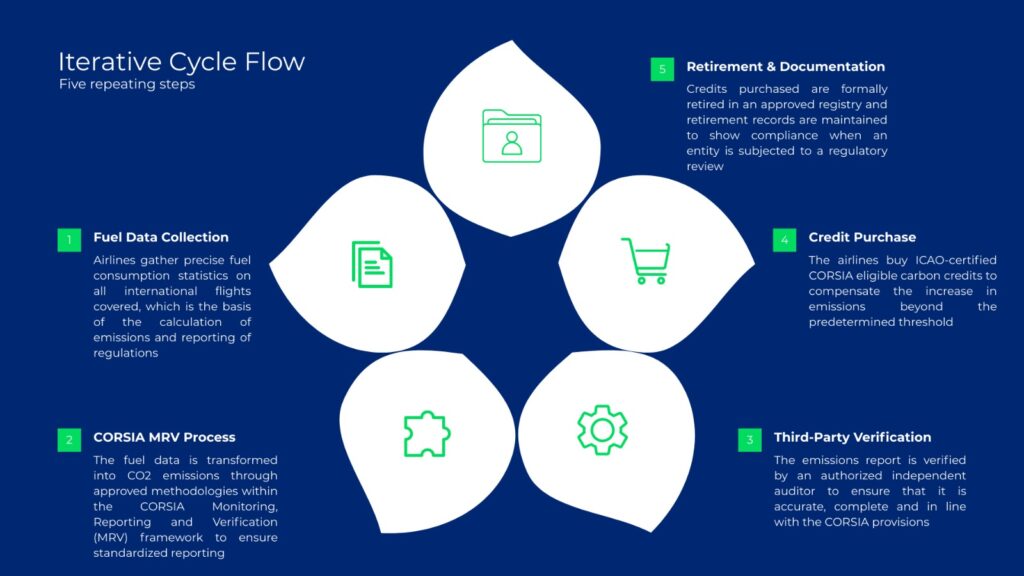
Figure: Iterative Carbon Offset Compliance Cycle in Airlines.
Carbon Offset Requirements Under CORSIA
After monitoring and verifying the emissions, airlines have to fulfill the Carbon Offset Requirements as specified by CORSIA. This obligation is estimated on the basis of the growth of emissions against the baseline and can have different variations based on the stage of implementation. This renders the future projections of emissions especially valuable in financial planning.
Carbon credits are not all eligible. Airlines will have to buy CORSIA-eligible carbon credits, which are obtained through programs that are approved by ICAO. Such credits should satisfy specified environmental standards of integrity and indicate that reductions are factual, verifiable, and not counted twice. Making procurement decisions should also not just be dependent on price alone, but also on confirming the eligibility and integrity of documentation.
Airlines must verify the eligibility criteria by ensuring that credits have been issued by an approved program by ICAO, have unique serial numbers, and have recorded their retirement records. It is crucial to keep a clear record of the offsets, just like when buying the credits. In the absence of evidence of retirement and traceability, the compliance position of an airline can be called into question when conducting a regulatory review.
Carbon offset planning must be developed as a systematic procurement plan and not a last-minute purchase at the end of the year. Airlines that forecast the volumes at an early stage are in a better position to deal with fluctuations in the market and prevent cost surges.
The 2027 Mandatory Phase – What Airlines Must Prepare For
The introduction of the CORSIA 2027 mandatory phase is the transition from voluntary to a full regulatory obligation of the majority of international routes between participating states. With the current schedule of implementation of CORSIA, airlines will have a restricted time to improve systems before the scheme is fully enforceable.
This operationally implies that Aviation Emissions Monitoring should not be addressed as a parallel process but as part of regular reporting procedures. The finance team, compliance team, and operational team should be aligned in such a way that the emissions data, verification schedules, and the offset procurement cycles are aligned. Airlines that depend on fragmented or manual processes can experience a bottleneck when the volume of reporting grows.
The other consideration is financial exposure. CORSIA eligible carbon credits may vary in cost depending on the market conditions and program availability. Airlines that delay procurement decisions until the last quarter can experience price volatility. Having a progressive buying program will minimize risks and enhance the predictability of the budget.
As an example, a mid-sized carrier with several long-haul international flights might inaccurately determine its offset obligation in case its baseline growth is not predicted properly. When there is a steady increase in emissions in two reporting intervals without prior plans to acquire credits, the airline may experience unanticipated compliance expenses at the start of the CORSIA 2027 mandatory phase. This risk is minimized by early modeling of offset exposure.
Before 2027, preparation should focus on creating stronger MRV systems, validating calculation methodologies, and conducting internal readiness reviews. A well-planned compliance roadmap will ease the operational stress as the mandatory phase commences. Since the mandatory phase of the CORSIA 2027 is close, the preparation process should transition out of planning and into an organized implementation:
CORSIA Compliance Checklist Pre 2027:
- Validate MRV systems
- Certify the baseline emission estimates.
- Gain access to CORSIA eligibility carbon credits.
- Keep certified retirement records.
Conclusion – Preparing for CORSIA Compliance Before 2027
The shift towards the mandatory stage elevates CORSIA Compliance to an essential regulatory requirement, like a push button, and not a visionary policy debate. Airlines that consider it a strategic business operational focus, not an annual reporting exercise, will be in a position to handle the regulatory and financial risk.
Through enhancing CORSIA Monitoring, Reporting, and Verification products, which are in line with ICAO CORSIA framework guidelines, and access to verified carbon offsets well in advance, the airlines can head into 2027 with a clear vision and control. Early planning helps in making audits smoother, costs can be forecasted, and a stronger assurance of compliance with regulatory expectations.
CORSIA Compliance before the year 2027 is all about preparation. The airlines that take the time to develop proper reporting systems and rigorous offset strategies will not enter the mandatory phase under pressure, but will do so prepared.
Econetix provides direct CORSIA-eligible supply from projects we own, helping you plan volumes early and match delivery to your CORSIA requirements. Book a CORSIA Sourcing Call with Econetix
Frequently Asked Questions (FAQs)
What does CORSIA Compliance require airlines to do?
CORSIA Compliance requires airlines to track and record their international flight emissions and have those records validated by an independent party, and purchase eligible carbon credits to cover additional emissions beyond the set baseline.
Who must comply with CORSIA monitoring, reporting, and verification?
International airlines flying between participating states must adhere to the rules of CORSIA monitoring, reporting, and verification, as long as they exceed the threshold of minimum emissions specified within the ICAO framework.
How are CORSIA emissions calculated for reporting purposes?
The calculation of emissions depends mainly on fuel consumption records of international flights. Airlines use approved methods to transform the consumption of fuel into CO2 emissions and report them as part of their annual reporting obligations.
What is the CORSIA emissions baseline, and how does it affect offset obligations?
The CORSIA emissions baseline is used as the benchmark in determining the offset obligations. In case an airline emits more than this base in a compliance year, the airline has to purchase and retire the carbon credits that it has emitted in excess of this base.
How does third-party verification work under CORSIA Compliance?
Prior to the submission of emissions reports to national authorities, an independent verifier who is accredited must review the report. To determine regulatory integrity, the verifier evaluates the accuracy of data, consistency of methods, and adherence to reporting standards.
